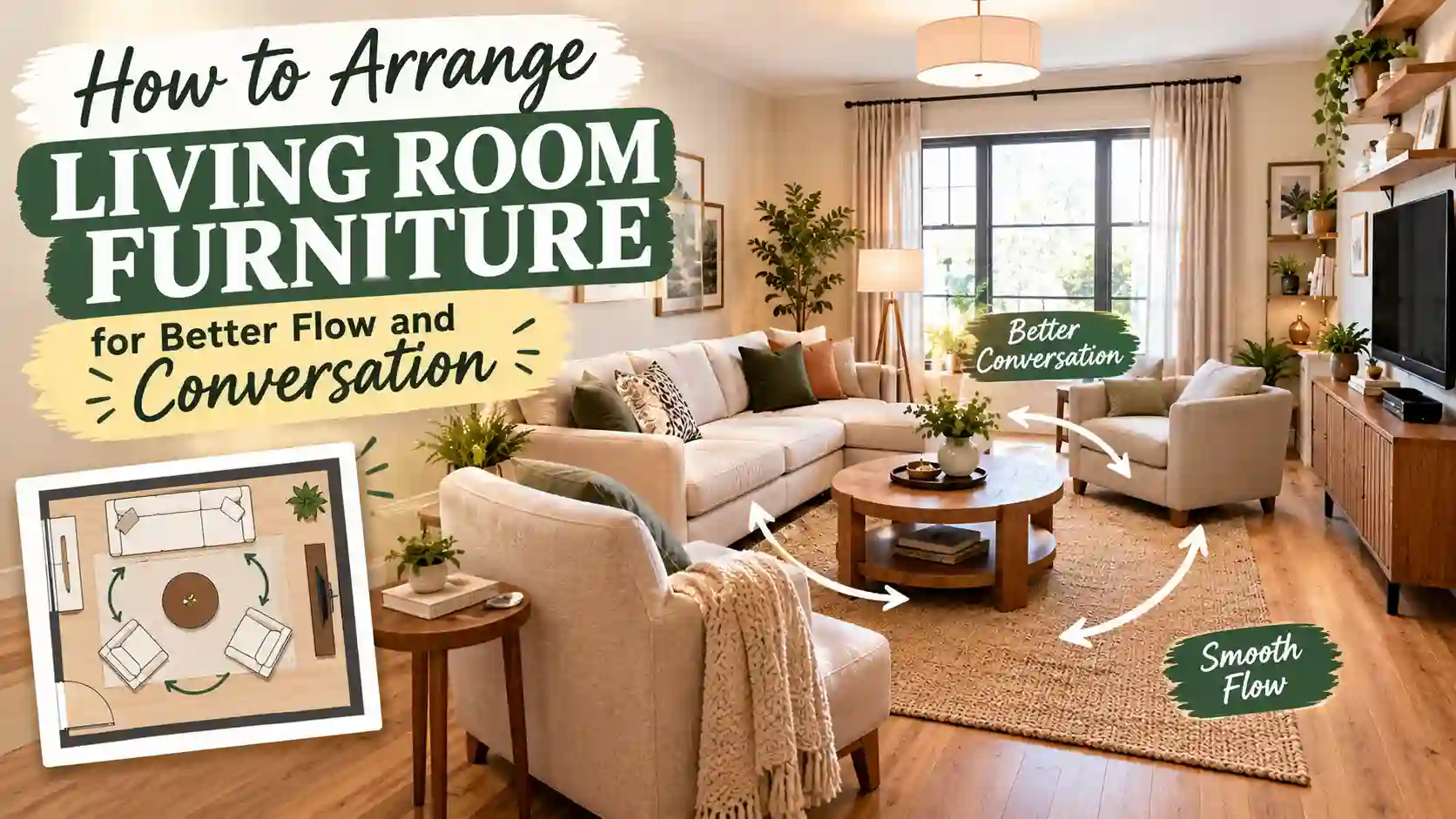
Arrange Living Room Furniture for Better Flow and Conversation: Think about the last time you walked into someone’s living room and immediately felt comfortable enough to sit down, relax, and actually talk. Chances are you didn’t consciously notice the furniture arrangement — but it was doing a lot of quiet work behind the scenes. Now think about the opposite: a room where you weren’t sure where to sit, everyone ended up shouting across the space, or you spent the whole visit staring at the back of someone’s head instead of their face.
That difference almost never comes down to how much furniture someone owns or how expensive it is. It comes down to arrangement. A living room can be filled with beautiful pieces and still feel awkward and disconnected if they’re placed without thought. Or it can be simple and budget-friendly and still feel like the warmest, most inviting room in the house, purely because the layout works.
If you’ve ever felt like your living room looks fine but doesn’t quite feel right, the furniture arrangement is almost always the missing piece. Here’s how to fix it.
Start With the Conversation, Not the TV
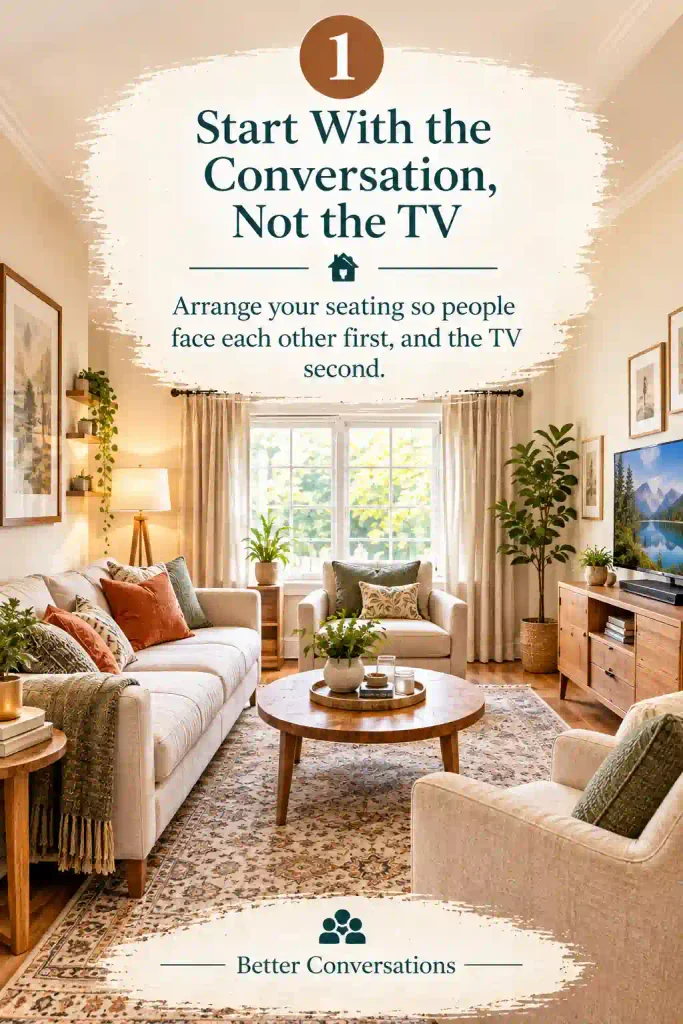
Most American living rooms are built around the television, with every seat angled toward the screen like a mini movie theater. There’s nothing wrong with prioritizing TV time, but if you want a room that actually encourages conversation, the seating needs to face each other first, and the TV second.
Try arranging your main seating — sofa, chairs, whatever you have — so people are looking at each other, not just at a screen. You can still see the TV from an angle without organizing the entire room around it. This one shift changes the entire emotional tone of a room, from “we’re all watching something” to “we’re actually here together.”
Keep Seating Within Talking Distance
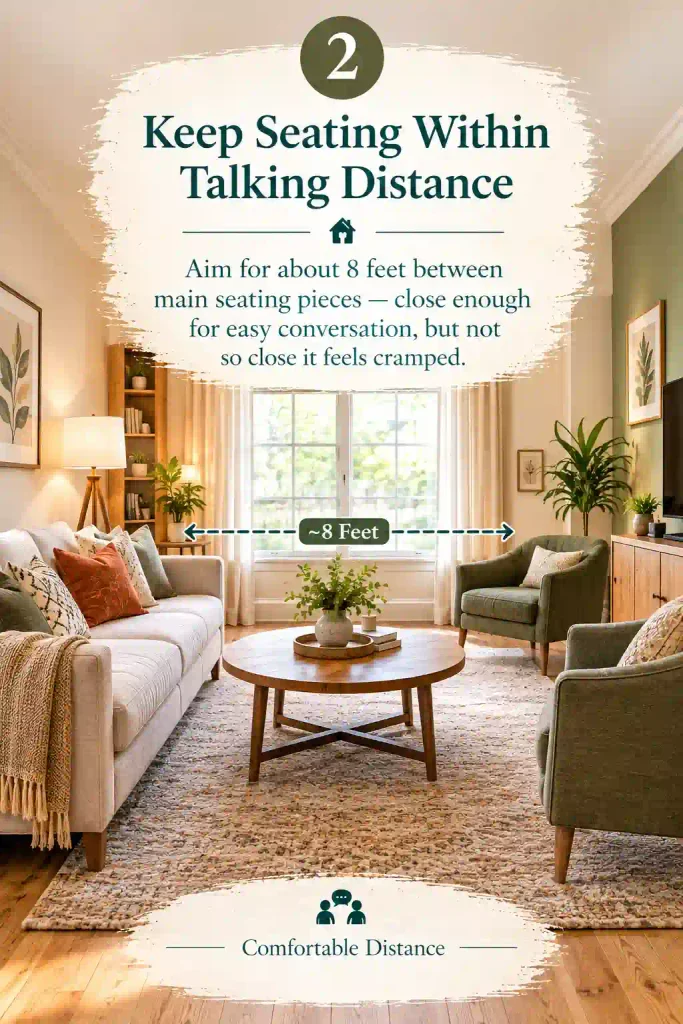
There’s a design principle worth remembering here: conversation works best when seating is close enough that people don’t have to raise their voice, but not so close that it feels cramped. As a general guideline, aim to keep your main seating pieces within about eight feet of each other. Beyond that distance, conversations naturally start to fragment into smaller side conversations instead of one shared moment.
This is especially important in larger living rooms, where it’s tempting to push all the furniture against the walls to “fill” the space. Resist that instinct. Pulling seating in toward the center, even in a bigger room, almost always creates a warmer, more connected feeling than lining everything up around the perimeter.
Create a Clear Path Through the Room
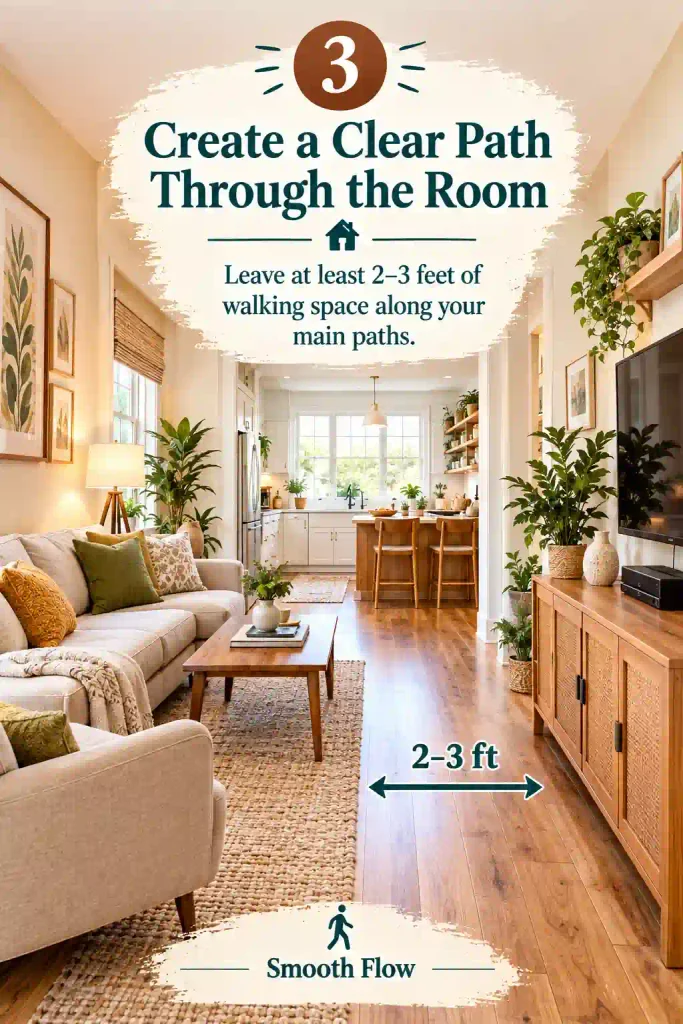
Nothing kills the flow of a living room faster than having to awkwardly squeeze past a coffee table or shuffle sideways around an ottoman just to reach the couch. Before you finalize any layout, walk through the space the way you actually would in daily life — from the doorway to the seating, from the seating to the kitchen, from the seating to the hallway.
As a rule of thumb, try to leave at least two to three feet of clear walking space along your main paths. If you find yourself rearranging your own limbs to get through the room, your guests will feel that same friction, even if they can’t quite name why.
Anchor the Room With a Rug
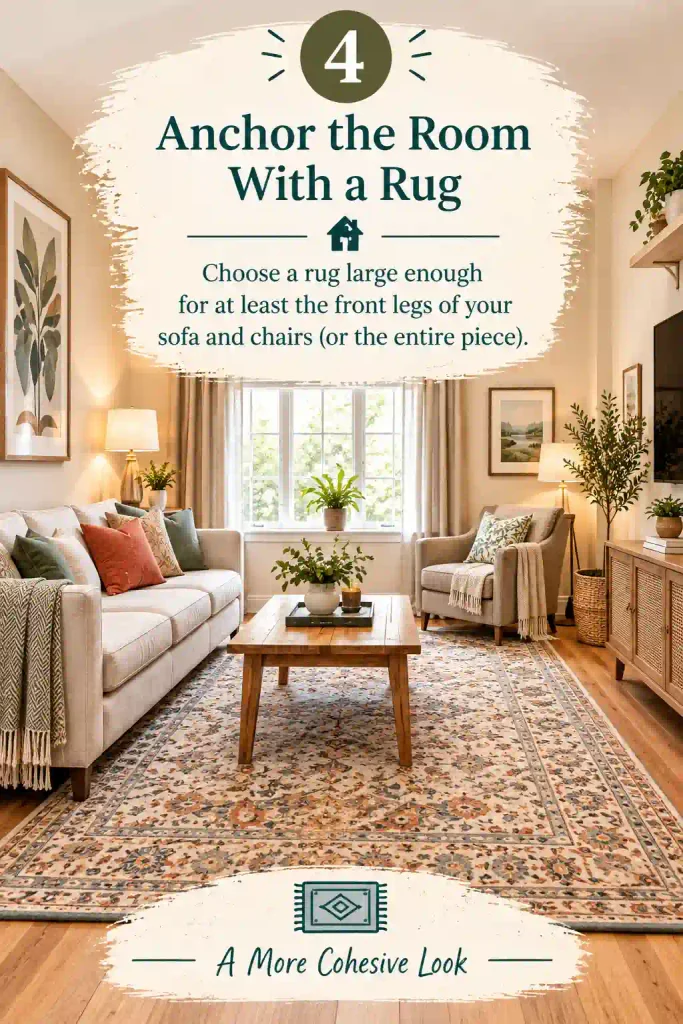
An area rug does more than add texture underfoot — it visually defines the conversation area and tells your eye where the “room within the room” begins and ends. A common mistake is choosing a rug too small for the space, which makes the furniture look like it’s floating on an island in the middle of the floor.
As a general guideline, try to get at least the front legs of your sofa and chairs on the rug, if not the entire piece. This single change can make a living room feel significantly more grounded and intentional, even if nothing else in the layout changes.
Use a Coffee Table as the Social Hub
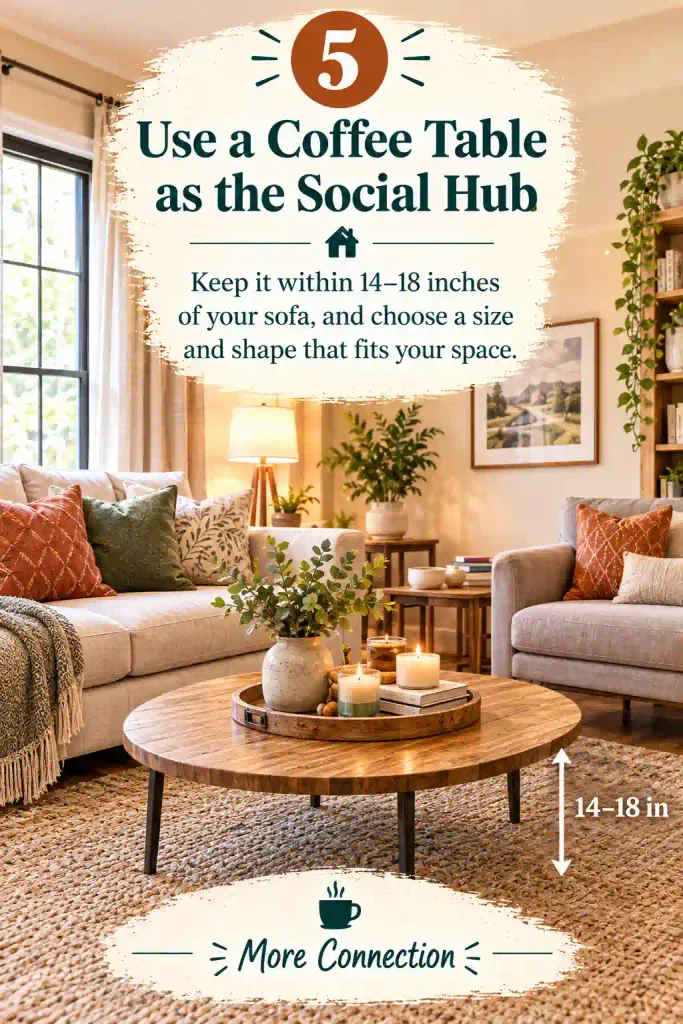
The coffee table often gets treated as an afterthought, but it plays a bigger role in conversation flow than most people realize. It’s the natural gathering point for drinks, snacks, board games, and the little pauses in conversation where someone reaches for their coffee instead of talking. Keep it within comfortable reach of every seat, ideally about 14 to 18 inches from the front of your sofa.
If your room is small, don’t skip the coffee table altogether — just size it down or choose a round shape instead of a rectangle. A small round table often fits better in a tight conversation area and reduces the number of sharp corners people have to navigate around.
Float Furniture Away From the Walls

It’s a common instinct, especially in smaller homes, to push every piece of furniture flat against the walls to maximize open floor space in the middle of the room. But this actually tends to work against you. When seating is pulled a few feet away from the walls and angled toward each other, the room almost always feels warmer and more intentional, even though technically there’s less “empty” floor space.
This doesn’t mean every piece needs to float. A console table or bookshelf can still hug the wall. But your main seating — the pieces people actually sit in to talk — benefits from being pulled inward, toward the heart of the room.
Balance the Room Visually, Not Just Functionally
A living room feels most comfortable when its visual weight is distributed evenly, rather than clustered on one side. If your sofa and both armchairs are all crowded into one half of the room, the space will feel lopsided no matter how good the individual pieces look.
Step back and look at the room the way you’d look at a photograph. Is there a heavy cluster of furniture on one side and an empty gap on the other? Small adjustments, like moving a floor lamp or a side table to the lighter side of the room, can restore a sense of balance that makes the whole space feel calmer.
Leave Room for More Than One Conversation
In larger living rooms, resist the urge to create one giant seating arrangement meant to hold every single person at once. Instead, consider a secondary seating spot, like two chairs angled toward each other in a corner, or a small bench near a window. This gives guests permission to break off into smaller, more intimate conversations instead of feeling stuck in one big group circle all night.
Some of the best hosted gatherings happen not because everyone was forced into one conversation, but because the room quietly offered a few different places for connection to happen.
Why This Actually Matters
A living room isn’t just a place to store your furniture — it’s where birthdays get celebrated, where friends catch up after a long week, where families actually sit down and talk to each other instead of just coexisting in the same house. The way that room is arranged either invites those moments or quietly gets in their way.
You don’t need new furniture to fix a living room that doesn’t feel right. Most of the time, the pieces you already own just need to be arranged with a little more intention. Move things closer together. Face them toward each other. Clear the paths. Small shifts like these can turn a room you merely walk through into one where people actually want to stay a while.